
Confederation Bridge: Canada’s Longest Bridge (12.9 km) — Toll Rates, Traffic Data & Construction Facts
New BrunswickConnecting Cape Jourimain, NB to Borden-Carleton, PE
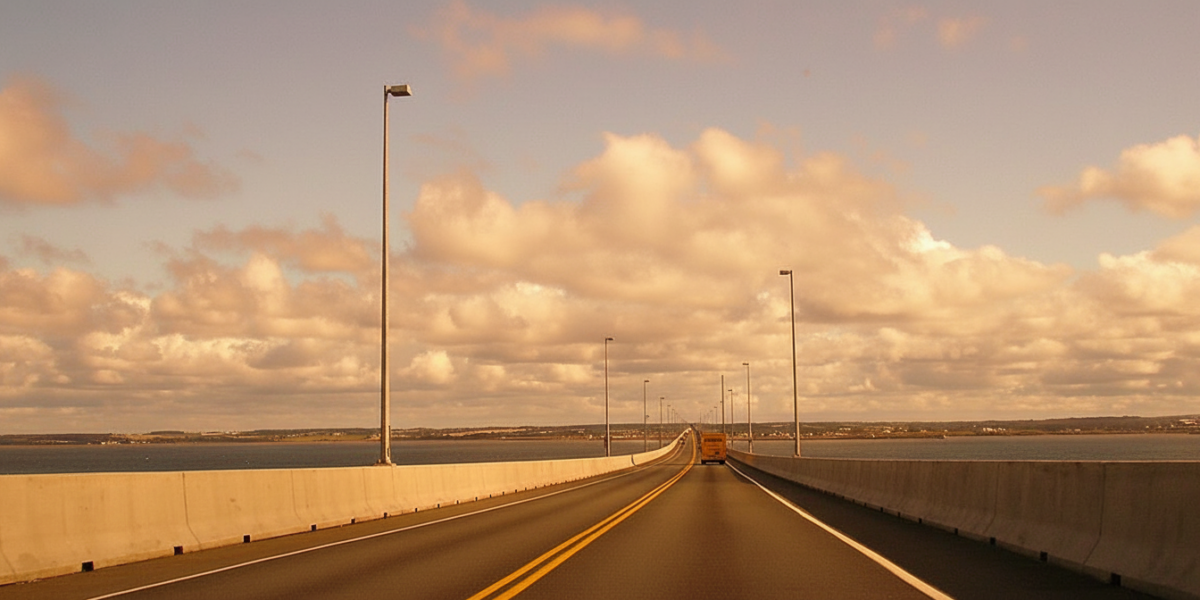
Confederation Bridge: Canada’s Longest Bridge
Stretching 12.9 km across the Northumberland Strait, the Confederation Bridge connects New Brunswick to Prince Edward Island and holds the distinction of being Canada’s longest bridge. It is also the longest bridge over ice-covered water in the world. Opened on May 31, 1997, the bridge replaced a ferry service that had linked the two provinces since 1938 — and fundamentally transformed PEI’s economy and way of life.
Bridge Statistics
| Detail | Value |
|---|---|
| Total Length | 12.9 km |
| Opened | May 31, 1997 |
| Construction Cost | $1 billion CAD |
| Builder | Strait Crossing Development Inc. |
| Number of Spans | 62 |
| Construction Type | Post-tensioned concrete box girder |
| Design Life | 100 years (to 2097) |
| Crossing Time | 12 minutes |
| Speed Limit | 80 km/h |
| Toll | $53.50/car (collected only when leaving PEI) |
| Total Vehicles Since Opening | 40.69 million |
Engineering and Design
The Confederation Bridge was an extraordinary feat of engineering. The Northumberland Strait presents a uniquely challenging environment: it freezes over each winter, generating massive ice forces against any structure in its path. The bridge was designed to withstand ice forces, hurricane-strength winds, and ship collisions — all while maintaining a 100-year service life.
The 62 spans of post-tensioned concrete box girder construction were largely prefabricated on shore, then floated into position and placed by massive crane barges. The main navigation span rises 60 metres above the water to allow large vessels to pass underneath. The gentle S-curve of the bridge is an intentional design feature to help drivers maintain alertness during the 12-minute crossing.
Replacing the Ferry
For nearly 60 years before the bridge, the MV Holiday Island and its predecessors operated a ferry service between Cape Jourimain, New Brunswick, and Borden-Carleton, PEI. The crossing took 45 minutes in good weather, but delays were frequent — particularly during winter ice conditions when service could be suspended for days at a time. The bridge provided the first permanent, fixed link between PEI and the Canadian mainland.
Wind Restrictions
The bridge’s exposed position over open water means wind is a constant factor:
- Winds over 60 km/h — High-profile vehicles (RVs, empty transport trucks, motorcycles) are banned from crossing
- Winds over 70 km/h — The bridge closes entirely to all traffic
- The bridge is fully closed an average of 17.3 days per year due to high winds
Pedestrians and cyclists are never permitted on the bridge. A shuttle service operates for those who wish to cross without a motor vehicle.
Economic Impact on PEI
The bridge’s impact on Prince Edward Island was immediate and dramatic. In the first full year after opening, tourism to PEI jumped 71.9%. The fixed link eliminated the uncertainty and scheduling constraints of ferry travel, making day trips and spontaneous visits possible for the first time. The toll is collected only when leaving PEI — crossing onto the island is free — a deliberate design to encourage visitors to come.
The bridge also transformed PEI’s freight and supply chain logistics. Fresh seafood, agricultural products, and manufactured goods could now reach mainland markets on a predictable schedule regardless of season or weather, reducing costs and expanding market access for island businesses.
The Toll
The current toll of $53.50 per passenger vehicle is collected at the toll plaza on the PEI side as vehicles leave the island. The toll was established to fund the bridge’s construction and ongoing maintenance. Motorcycles pay $20.25, while commercial vehicles are charged based on axle count. Cash, credit cards, and the pre-paid Confederation Bridge Pass are all accepted.
Crossing the Bridge
The 12-minute crossing at 80 km/h offers panoramic views of the Northumberland Strait in both directions. On clear days, both the New Brunswick and PEI coastlines are visible simultaneously from the bridge’s midpoint. In winter, the frozen strait stretching to the horizon is a remarkable sight. The bridge is open 24 hours a day, 365 days a year, weather permitting — a stark improvement over the ferry era when the last sailing was often early evening.