
The Bluenose: Canada’s Most Famous Schooner — Undefeated Racing Record, History & the Canadian Dime
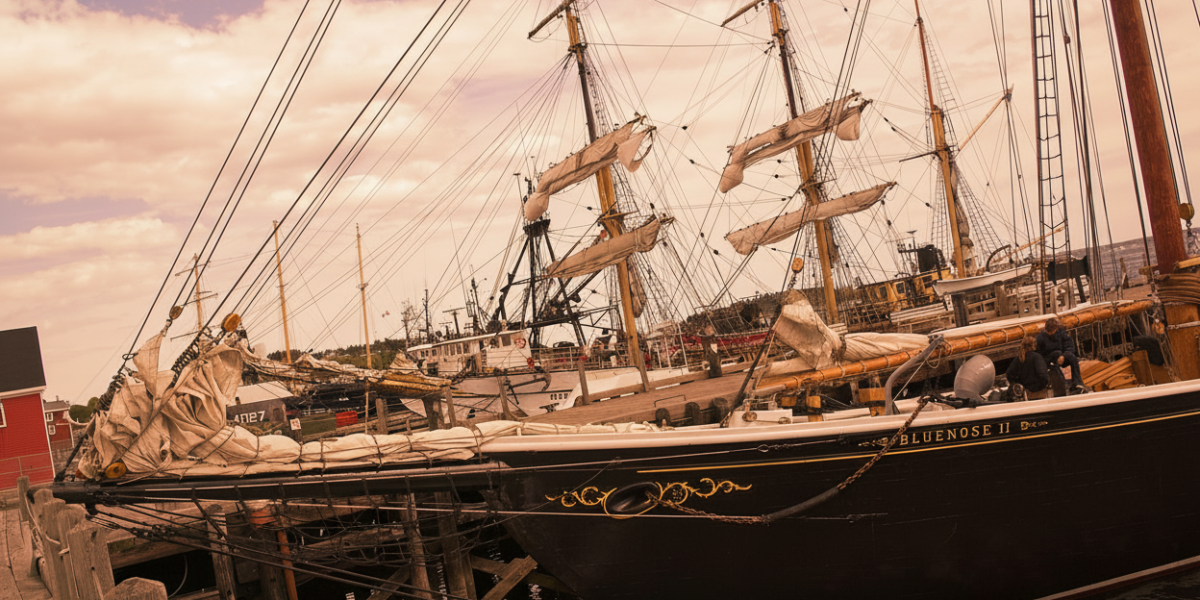
The Bluenose is more than a ship — it is a Canadian national symbol. Built in 1921 in Lunenburg, Nova Scotia, this fishing and racing schooner dominated the International Fishermen’s Trophy for 17 years, became one of the most celebrated vessels in maritime history, and has appeared on the Canadian dime since 1937.
Origins: Why the Bluenose Was Built
In 1920, the International Fishermen’s Trophy was created as a working fishermen’s alternative to the America’s Cup. The rules required competing vessels to have spent at least one season fishing the Grand Banks — no purpose-built racers allowed.
That first year, the American schooner Esperanto from Gloucester, Massachusetts defeated the Canadian entry. The loss stung Nova Scotia’s fishing communities deeply. Publisher William H. Dennis and a group of Halifax businessmen commissioned a new vessel designed to win back the trophy — while remaining a legitimate working fishing schooner.
Design and Construction
Naval architect William J. Roue, a self-taught designer from Halifax, created the plans. The vessel was built at the Smith and Rhuland shipyard in Lunenburg:
- Length: 43.6 m (143 ft)
- Beam: 8.2 m (27 ft)
- Draft: 4.9 m (16 ft)
- Tonnage: 285 gross tons
- Sail area: 930 m² (10,000 sq ft)
- Hull: Nova Scotia spruce and birch
- Launched: March 26, 1921
- Cost: $35,000 (~$550,000 in 2026 dollars)
Roue’s genius was the hull — a deeper keel and sharper entry than typical fishing schooners gave superior speed without sacrificing cargo capacity and seaworthiness for Grand Banks work.
Captain Angus Walters
Captain Angus J. Walters of Lunenburg skippered the Bluenose throughout her racing career. A third-generation fisherman at sea since age 13, Walters was known for competitive fire and stubborn refusal to accept defeat. He and the Bluenose became inseparable in public imagination.
The Undefeated Racing Record
| Year | Opponent | Result | Location |
|---|---|---|---|
| 1921 | Elsie (Gloucester, MA) | Won 2-0 | Halifax |
| 1922 | Henry Ford (Gloucester) | Won 2-1 | Gloucester |
| 1923 | Columbia (Gloucester) | Won 2-0* | Halifax |
| 1931 | Gertrude L. Thebaud | Won 2-0 | Halifax |
| 1938 | Gertrude L. Thebaud | Won 3-2 | Gloucester/Boston |
*1923 series controversial: Americans protested and withdrew.
The Bluenose never lost a series in 17 years of international competition.
Working Life on the Grand Banks
Between races, the Bluenose was a working fishing vessel. Each spring she headed to the Grand Banks with 20-25 crew using traditional dory fishing methods — hand-lining for cod, halibut, and haddock. In her best season, she landed over $50,000 worth of fish — remarkable for the 1920s. She was consistently one of Lunenburg’s top producers.
The Canadian Dime
In 1937, the Royal Canadian Mint selected the Bluenose for the Canadian ten-cent coin. Engraver Emanuel Hahn’s design shows the schooner under full sail. It has appeared on every Canadian dime since — making the Bluenose one of the most reproduced images in Canadian history and cementing her status as a national icon.
Tragic End
By the late 1930s, working sail was dying. Unable to find a Canadian buyer, Captain Walters reluctantly sold the Bluenose in 1942 to the West Indies Trading Company. Used as a Caribbean cargo freighter, she struck a reef off Ile a Vache, Haiti on January 28, 1946 and sank. Walters never recovered from the loss.
Bluenose II: The Living Replica
In 1963, the Oland family financed Bluenose II, built at the same Smith and Rhuland shipyard using original plans. After a complete $25 million rebuild (2010-2013), she serves as Nova Scotia’s official sailing ambassador. Visit her at the Lunenburg waterfront (June-September) or at maritime festivals across Atlantic Canada.
Visiting the Bluenose Heritage
- Fisheries Museum of the Atlantic, Lunenburg: Extensive Bluenose exhibit with original artifacts
- Lunenburg Waterfront: Home port of Bluenose II
- Bluenose II Sailing Tours: 2-hour trips available in summer
- Canadian Museum of History, Gatineau: Maritime collection
Sources: Maritime Museum of the Atlantic, Library and Archives Canada, Nova Scotia Archives. Racing record from Halifax Herald and Gloucester Daily Times archives.