
Samuel de Champlain Bridge Montreal: $4.2 Billion Cable-Stayed Crossing — Facts & Engineering Data
QuebecConnecting Montreal to Brossard
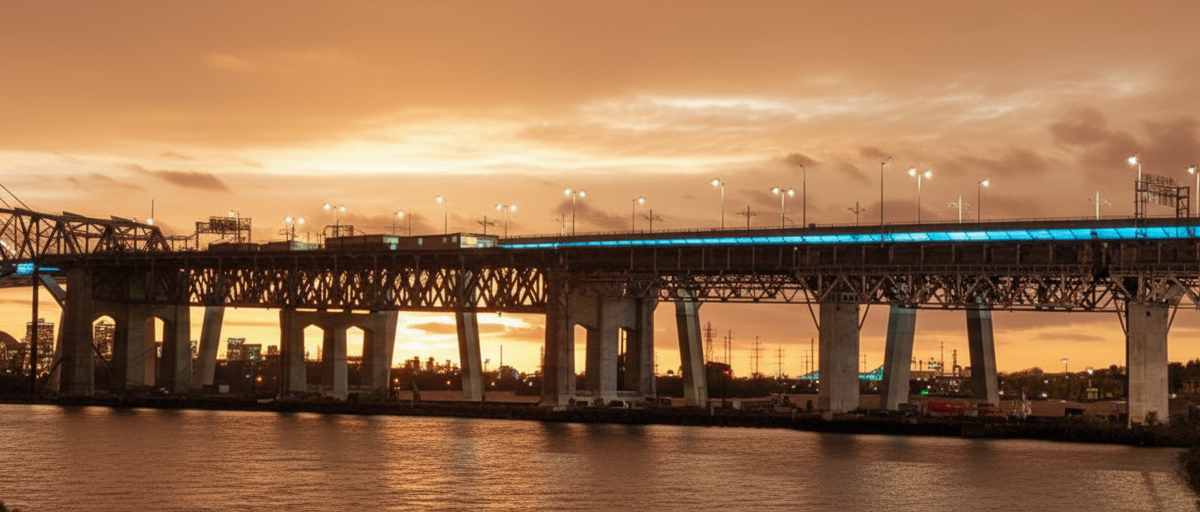
The Samuel de Champlain Bridge is the most expensive infrastructure project in Canadian history, a $4.239 billion cable-stayed bridge spanning the St. Lawrence River in Montreal. Opened in 2019, it replaced the deteriorating original Champlain Bridge (1962) and carries approximately 50,000 vehicles daily — making it one of the busiest crossings in Canada.
Bridge Specifications
| Specification | Details |
|---|---|
| Total Length | 3,400 m (3.4 km) |
| Main Span | 240 m cable-stayed section |
| Width | Deck width accommodates 6 traffic lanes + dedicated transit corridor + multi-use path |
| Tower Height | 170 m — tallest structure in Greater Montreal |
| Construction Cost | $4.239 billion CAD |
| Construction Period | 2015-2019 (4 years) |
| Daily Traffic | ~50,000 vehicles |
| Toll | Free (no toll for vehicles) |
| Design Life | 125 years |
Why It Was Built: The Original Champlain’s Decline
The original Champlain Bridge, opened in 1962, was one of Canada’s busiest bridges carrying 40-60 million vehicle crossings annually. By the 2000s, it was in critical structural decline — corrosion from road salt and de-icing chemicals had severely weakened the reinforced concrete. Emergency repairs cost hundreds of millions, and engineering assessments warned of potential catastrophic failure. The federal government fast-tracked the replacement project in 2014.
Engineering Highlights
- Asymmetric cable-stayed design: The distinctive single tower with cables creates a dramatic silhouette on Montreal’s skyline
- REM transit corridor: A dedicated lane for the Reseau express metropolitain (REM) light rail system, opened 2023 — the first North American bridge designed from the start to integrate rapid transit
- Multi-use pathway: A 3.4 km cycling and pedestrian path runs the entire length, offering views of the St. Lawrence and Montreal skyline
- LED lighting: Programmable architectural lighting illuminates the tower and cables, creating a nighttime landmark visible across the city
- Ice protection: The bridge piers are designed to withstand massive ice floes from the St. Lawrence spring breakup
P3 Delivery Model
The bridge was built as a Public-Private Partnership (P3) by Signature on the Saint Lawrence (SSL), a consortium led by SNC-Lavalin. The consortium will maintain the bridge for 30 years before transferring ownership to the federal government. This delivery model was chosen to meet the aggressive 4-year construction timeline.
Crossing the Bridge
Unlike the Confederation Bridge or Gordie Howe Bridge, the Samuel de Champlain Bridge charges no toll. It connects the island of Montreal (at Nun’s Island) to Brossard on the South Shore. The REM transit line offers a car-free alternative — the ride from Brossard to downtown Montreal takes approximately 15 minutes.
Sources: Infrastructure Canada, Jacques Cartier and Champlain Bridges Incorporated, Signature on the Saint Lawrence. Bridge data current as of 2026.